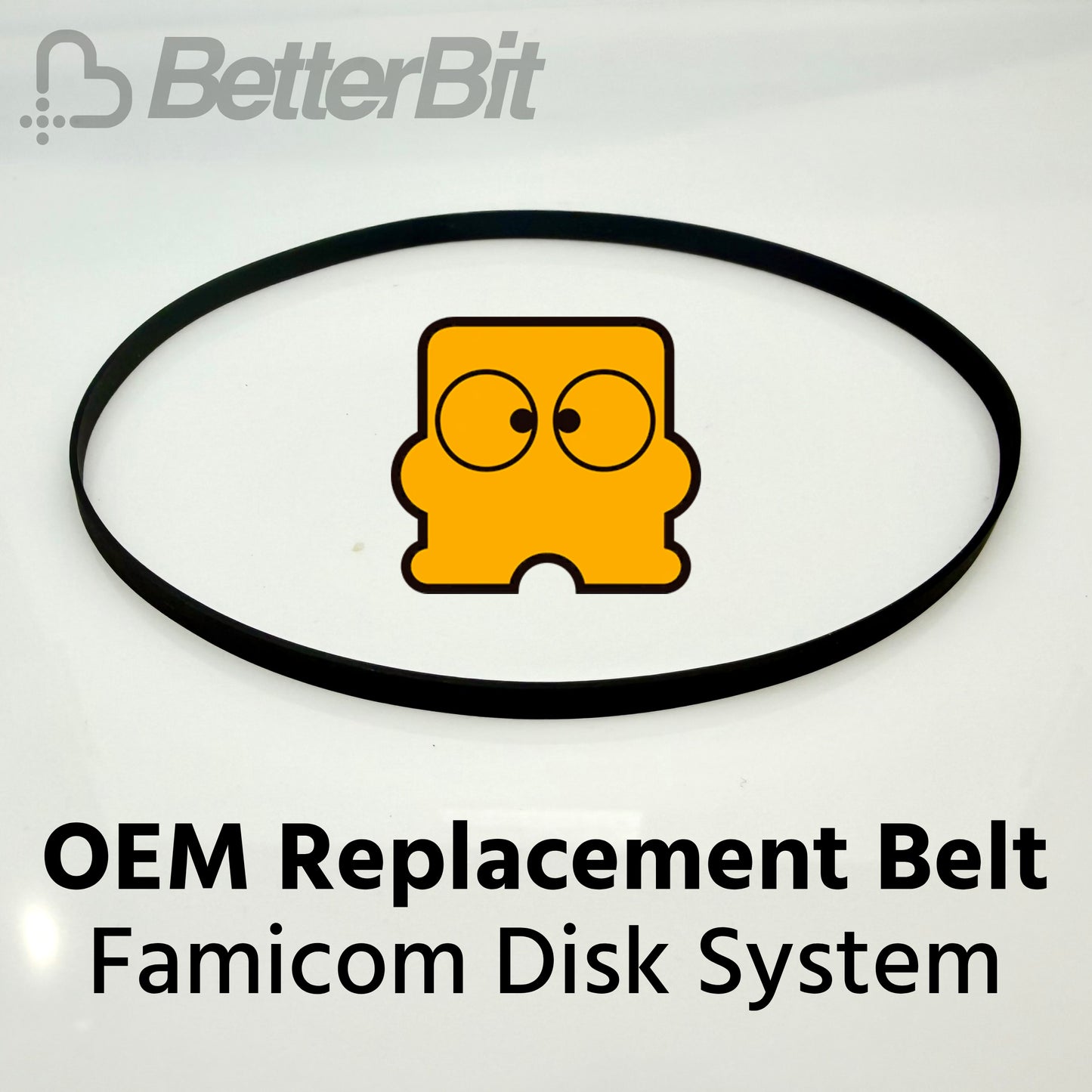
Famicom Disk Drive OEM Replacement Belt for FDS
Famicom Disk Drive OEM Replacement Belt for FDS
Couldn't load pickup availability
This listing includes:
- 1 × OEM-Spec Precision Replacement Belt for the Nintendo Famicom Disk System (FDS).
- This listing currently includes 15 business days of handling time while I ramp up my manufacturing for parts.
Technical Specifications
- Fold Length: 116.50 mm
- Width: 3.00 mm
- Thickness: 1.00 mm
- Young's Modulus: 5.00 MPa (Megapascals)
- Hardness: 55 Shore A
Frequently Asked Questions (FAQ)
What happens if I use a belt with the wrong Shore Durometer or Young's Modulus? The tension translated to the drive system will be incorrect. If the material is too stiff, it creates excessive radial load (causing reduced RPM and premature wear on the delicate motor and spindle bushings). If it is too soft, it causes belt slippage, resulting in speed fluctuations and read errors.
Why do these material specs matter? These physical properties are imperative to replicate the exact factory-intended tension on the motor and pulley assembly during operation.
How can you claim this is an "OEM" specification? I provide precision repair and calibration services for Famicom Disk Drives. Thanks to this volume of work, I have had the rare opportunity to source and measure original Nintendo rubber belts that survived the decades without disintegrating or melting. (Please note: While the FDS was released in 1986, Nintendo officially offered factory service for these drives all the way until 2007).
How did you arrive at this exact folded length? The required belt path length is dictated entirely by the fixed geometry of the pulleys and their center-to-center distance, making the required physical belt size mathematically indisputable.
My drive still doesn't work after installing the new belt! Reassembly of the disk spindle pulley mechanism requires strict mechanical alignment. Additionally, it is often necessary to recalibrate the motor speed after a belt swap. You can find comprehensive guides on this process online, including detailed calibration and repair videos I have released based on my workshop experience.
How and where should I measure the drive's RPM? I strongly recommend measuring your RPM using a calibrated digital contact tachometer (Stroboscopic smartphone apps have proven unreliable in testing). RPM can be verified at two locations:
- Motor Pulley: Approximately 2293 RPM
- Disk Spindle Hub: Must target 400 RPM. it is normal for the spindle to fluctuate between 399 RPM and 408 RPM as it traverses the internal cam mechanism.
Terms of Sale & Disclaimer
- I do not offer a warranty on the installation process or user-inflicted damage to the belt or drive.
- FDS calibration is a delicate procedure. I strongly recommend paying for a professional installation service if you are not experienced with micro-mechanics.
- If you have any technical questions or concerns, please feel free to reach out BEFORE purchasing.
Share